
Build · Cash and runway
How much runway a startup needs, and when to start raising
Cash divided by burn gives you a number. It's not your runway. Here's how to work out the month cash really runs out, whether you're default alive, and the date you have to start raising.
By The Financial Mastery Team · Updated October 26, 2026 · 5 min read
You have $450,000 in the bank and you burn about $44,000 a month. Divide one by the other and you get ten months. Most founders stop there. That number is close, but it hides the two things that matter most: the month you have to start raising, and whether you ever need to.
Runway isn't a fact about your bank account. It's a forecast: what cash does when revenue and costs both keep moving. This guide walks through one company's numbers end to end, the same numbers the free calculator below starts with, so you can swap in your own.
The quick answer
Runway is the number of months until your cash runs out, given how revenue and costs are actually changing. Most seed-stage founders aim for 18 to 24 months after a raise, and start the next raise with at least 6 to 9 months of cash still left, because a round usually takes several months from first meeting to money in the bank.
Why cash ÷ burn is the wrong runway
Take a company with:
- $450k in the bank
- $18k of monthly revenue, growing 6% a month
- $62k of monthly costs, growing 2% a month as it hires
Net burn today is $62k − $18k = $44k. Cash ÷ burn says 10.2 months.
Now run it month by month. Revenue grows faster than costs in percentage terms, but from a much smaller base, so in dollars the gap barely moves:
| Month | Revenue | Costs | Net burn | Cash at month end |
|---|---|---|---|---|
| 1 | $18.0k | $62.0k | $44.0k | $406k |
| 3 | $20.2k | $64.5k | $44.3k | $318k |
| 6 | $24.1k | $68.5k | $44.4k | $184k |
| 8 | $27.1k | $71.2k | $44.2k | $96k |
| 10 | $30.4k | $74.1k | $43.7k | $8k |
| 11 | $32.2k | $75.6k | $43.3k | −$35k |
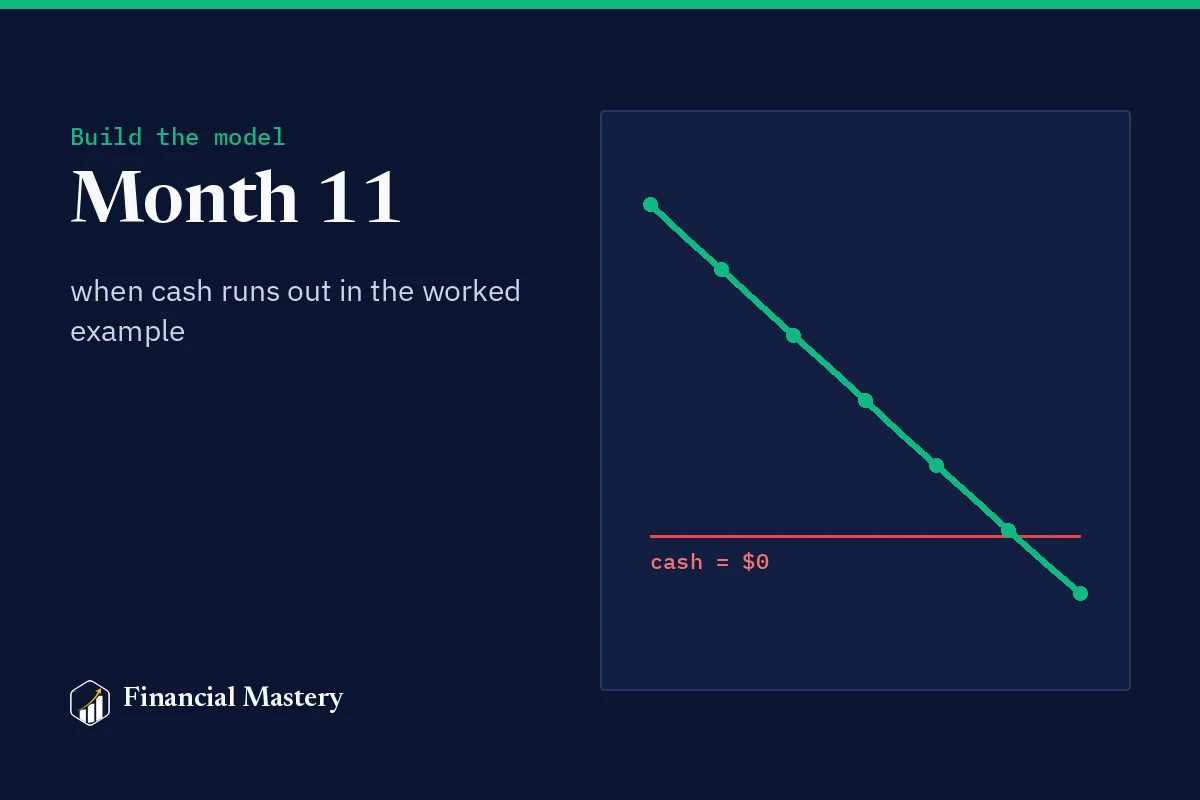
Cash goes negative in month 11. In this case the shortcut was nearly right, because growth and hiring cancelled out. Change either and it won't be: hire two engineers in month 3 and the shortcut overstates your runway; land a large annual contract and it understates it. The only way to know is the month-by-month view.
Use the last three months
Calculate burn as the average of your last three months, not your best month. One-off items (an annual software bill, a big customer prepaying) make any single month misleading.
Try it with your own numbers
Startup Runway Calculator
Default alive or default dead?
Paul Graham's question is the one investors are silently asking: if you raised nothing more and kept your current trajectory, would you reach profitability before the money runs out?
In our example revenue overtakes costs in month 34. Cash runs out in month 11. That's 23 months short, so the company is default dead. It isn't a judgement on the business; it's a fact about the plan. It means one of three things has to change:
- Raise. To reach month 34 on this plan, the company needs roughly $660k more than it has today, because that's how deep cash goes before burn turns positive. Investors will want a cushion on top of that.
- Cut burn. Taking $10k a month out of costs (say, a hire delayed) moves cash-out from month 11 to month 14 and break-even from month 34 to month 29. Still default dead, but a much easier raise.
- Grow faster. Revenue growth is the lever that compounds. It's also the one you control least in the short term.
Most founders end up doing some of all three. The point of the model is to see the trade-off in months, not guess it.
How much runway is enough?
There's no single right number, but the logic behind the common answer is simple:
- 18 to 24 months after a round. That's long enough to hit the milestones the next investor will look for, with time left to raise again.
- Start raising with 6 to 9 months left. Raises often take three to six months. Starting with 9 months of cash means you can walk away from a bad term sheet. Starting with 3 means you can't.
- Keep a cushion. Add two or three months for the round that takes longer than planned. It almost always does.
For our company, 6 to 9 months before month 11 means the raise has to start between month 2 and month 5. That's the date that belongs in your calendar, not the date the bank account hits zero.
Five things that quietly shorten runway
- Hiring dates that slip forward. A hire planned for month 6 that starts in month 3 costs three extra months of salary, plus recruiting fees.
- Payment terms. Revenue you invoice isn't cash you have. If enterprise customers pay on 60-day terms, your cash runway is shorter than your P&L suggests.
- Annual bills. Insurance, software renewals and audit fees land in one month. Spread them in the P&L if you like, but your cash forecast must show the lump.
- Sales tax and payroll tax timing. Money you collect for someone else isn't yours to spend.
- Optimistic churn. A 1% monthly churn assumption that's really 3% compounds into a very different revenue line by month 12.
Each of these is a reason investors ask to see a full three-statement model, not just a burn chart: the balance sheet and cash flow statement are what catch timing problems. Our investor-ready model checklist covers the checks an analyst will run.
A runway routine that takes 20 minutes a month
- Close the month. Update cash, revenue and costs with actuals.
- Recalculate three-month average burn. Watch the trend, not the single month.
- Re-run the forecast. Has cash-out moved? By how much, and why?
- Check the raise date. If cash-out moved earlier, the fundraise start date moved too.
- Write one line for your investors or co-founders. "Runway is 14 months, down from 15, because the two hires started early." That sentence is worth more than any chart.
If you've already raised and need a week-by-week view of the next quarter, read the guide to the 13-week cash flow forecast.
In the kit · Financial Mastery Lite · $99
See your runway month by month, for 60 months
The Lite kit's 3-statement model runs revenue, hiring and costs through a full P&L, balance sheet and cash flow, then shows runway, burn and the month cash hits zero on one tab. Type into the yellow cells and the Checks tab confirms it all ties together.
11 files, 4 PDF books. Works in Excel, Google Sheets and LibreOffice. The kit page shows the full contents and the first 12 pages of its Launch Plan.

Prefer to start free? Open the calculator or find the kit that fits.
Keep reading

Build the model · 4 min
What investors check in your financial model in the first ten minutes
Analysts don't read your model top to bottom. They run a short sequence of checks, and the first failure colours everything after it. Here's that sequence, with the numbers they look for.
April 13, 2026
Run the company · 5 min
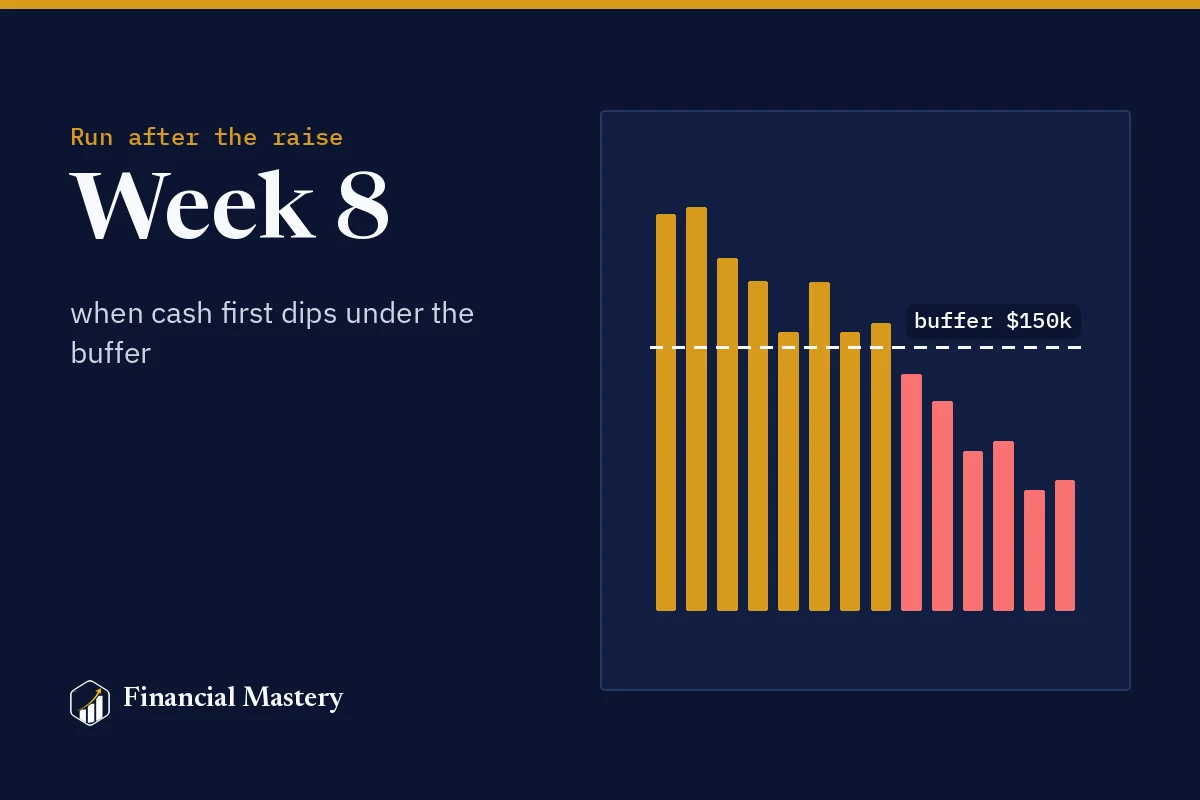
How to build a 13-week cash flow forecast and use it every Monday
Monthly forecasts hide the week your payroll and a tax bill land together. A 13-week cash flow shows it. How to build one, how to roll it every Monday, and how one company found its problem week before it arrived.
July 6, 2026
Run the company · 3 min
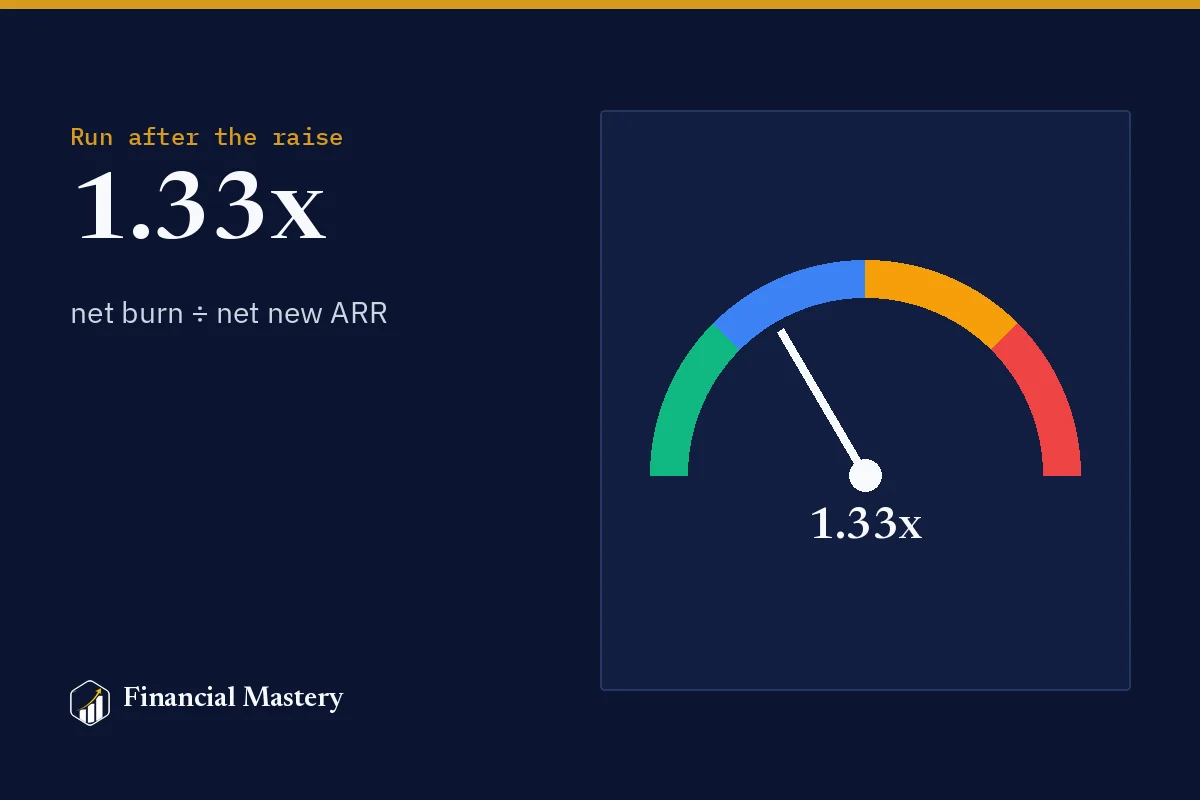
Burn multiple is the ratio your next investor will calculate
Net burn divided by net new ARR. Simple to calculate, hard to fake, and the quickest read on whether your growth is worth what it costs. With worked examples, the usual ranges and what moves it.
May 18, 2026