
Raise · Sizing the round
How much should a startup raise? Work it out from burn
Your round size should come from three numbers: how fast you'll spend after the round, how long you need, and how much you'll burn while you raise. A worked example from $300k in the bank to a $1.25M ask.
By The Financial Mastery Team · Updated October 26, 2026 · 4 min read
- $1.21M
- minimum raise in the worked example
- $1.25M
- the ask, rounded up
- 13.5%
- of the company at an $8M pre-money
"We're raising a million." Investors hear that sentence every day, and the next question is always the same: why a million? If the honest answer is that it sounds like a seed round, you've already lost the room.
A good round size is the result of a calculation you can explain in under a minute. Here's the calculation, with one company's numbers from start to finish.
The quick answer
Raise enough to fund 18 to 24 months of your post-round burn, plus a few months of cushion, minus the cash you'll still have when the money lands. Remember that burn rises after a round because you hire, and that you'll keep spending while you raise.
Step 1: Burn while you raise
Our company has $300k in the bank and burns $45k a month. The founders expect the raise to take 4 months from first meeting to money in the bank.
- Burn during the raise: 4 × $45k = $180k
- Cash left when the round closes: $300k − $180k = $120k
Founders often skip this step and count today's cash as if it will still be there at close. It won't.
Step 2: Burn after the round grows
The round exists to pay for hires, and hires push burn up. The founders plan for burn to grow 3% a month after closing. That doesn't sound like much, but it compounds:
| Month after close | Monthly burn |
|---|---|
| 1 | $46k |
| 12 | $64k |
| 18 | $77k |
| 21 | $84k |
Burn nearly doubles over the plan. If you size the round on today's $45k, you'll run out months early.
Step 3: Pick the runway you're buying
The founders want 18 months of runway after the round, plus a 3-month cushion for the next raise taking longer than planned. That's 21 months of growing burn.
- Total burn over those 21 months: about $1.33M
- Minus cash at close: $1.33M − $0.12M = $1.21M minimum
- Rounded to a clean number investors expect: a $1.25M ask
At an $8M pre-money valuation, $1.25M buys investors $1.25M ÷ $9.25M = about 13.5% of the company.
Try it with your own numbers
How Much Should I Raise? Calculator
What the runway choice does to the ask
The 18-month choice drives everything. Same company, same burn growth:
| Runway + cushion | Minimum raise |
|---|---|
| 12 months, no cushion | about $0.54M |
| 18 + 3 months | about $1.21M |
| 24 + 3 months | about $1.77M |
Twelve months is usually too short: by the time you've hired and shipped, you're fundraising again. Twenty-four is comfortable but means more dilution now. Most seed plans land in between, and the right answer depends on the milestones you need to hit, which is the next point.
Tie it to milestones
The strongest version of your ask names what the money buys: "$1.25M gets us to $1M ARR and 18 months of runway, which is what Series A investors in our category look for." Investors fund milestones, not months.
Round size and dilution: the trade-off
Raising more buys safety and costs ownership. Raising less keeps ownership and risks running short before you've earned a better valuation. A few rules of thumb founders use:
- Seed rounds commonly sell 10 to 25% of the company. If your number lands far outside that, check the valuation assumption or the burn plan.
- Each extra month of runway has a price you can now calculate. In our example, going from 18 to 24 months adds about $0.56M to the round.
- The option pool counts too. If investors ask for the pool to be topped up before they invest, that dilution is on top of the 13.5%. The option pool shuffle explains how.
To see what founders own after this round and the next two, try the dilution calculator. If part of your money is coming in on SAFEs first, the conversion maths is in the next guide.
Turning the number into a use-of-funds slide
Once you have the ask, the use-of-funds slide nearly writes itself, because it comes from the same plan:
- Hiring: the roles, start months and fully loaded cost from your headcount plan (usually the largest line).
- Go-to-market: paid acquisition, events and tools, tied to the customer targets in your revenue build.
- Product and infrastructure: what you build and run.
- Cushion: the 3 months you added on purpose. Say so; investors respect it.
Show it as percentages of the round and as the milestone each line buys. The pitch deck guide has a wireframe for the ask slide.
Questions investors will ask about your number
- "What does this get you to?" Answer with a milestone and a month.
- "What happens if the round is smaller?" Know your minimum, the $1.21M here, and what you'd cut to make $1M work.
- "Why is burn growing 3% a month?" Point to the hiring plan.
- "When do you raise next?" With 18 months of runway, you start in about month 9 to 12.
More questions like these, with what investors are really checking, are in our list of 50 investor questions.
In the kit · Financial Mastery Starter · $297
Plan the round with Base, Best and Worst cases
The Starter kit adds three scenarios, a Raise Planner and a Use of Funds planner to the model, plus a full cap table, so the amount you ask for, what it pays for and what it costs you in ownership all come from the same numbers.
18 files, 9 PDF books. Works in Excel, Google Sheets and LibreOffice. The kit page shows the full contents and the first 12 pages of its Launch Plan.

Prefer to start free? Open the calculator or find the kit that fits.
Keep reading
Plan the raise · 4 min
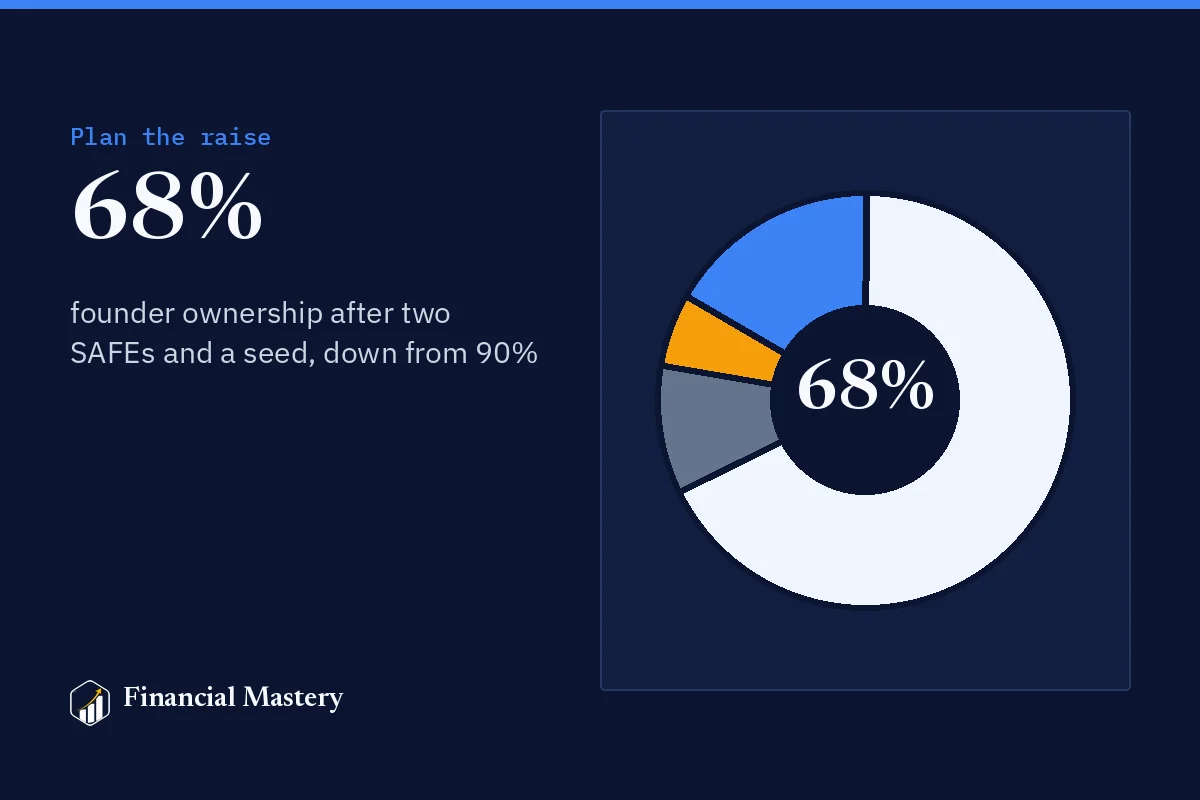
How post-money SAFEs dilute founders, shown on one cap table
Two SAFEs, a $2M priced round and an option pool top-up: follow every share from 90% founder ownership to about 68%, and see which SAFE term actually decides the price each investor pays.
March 9, 2026
Run the company · 5 min
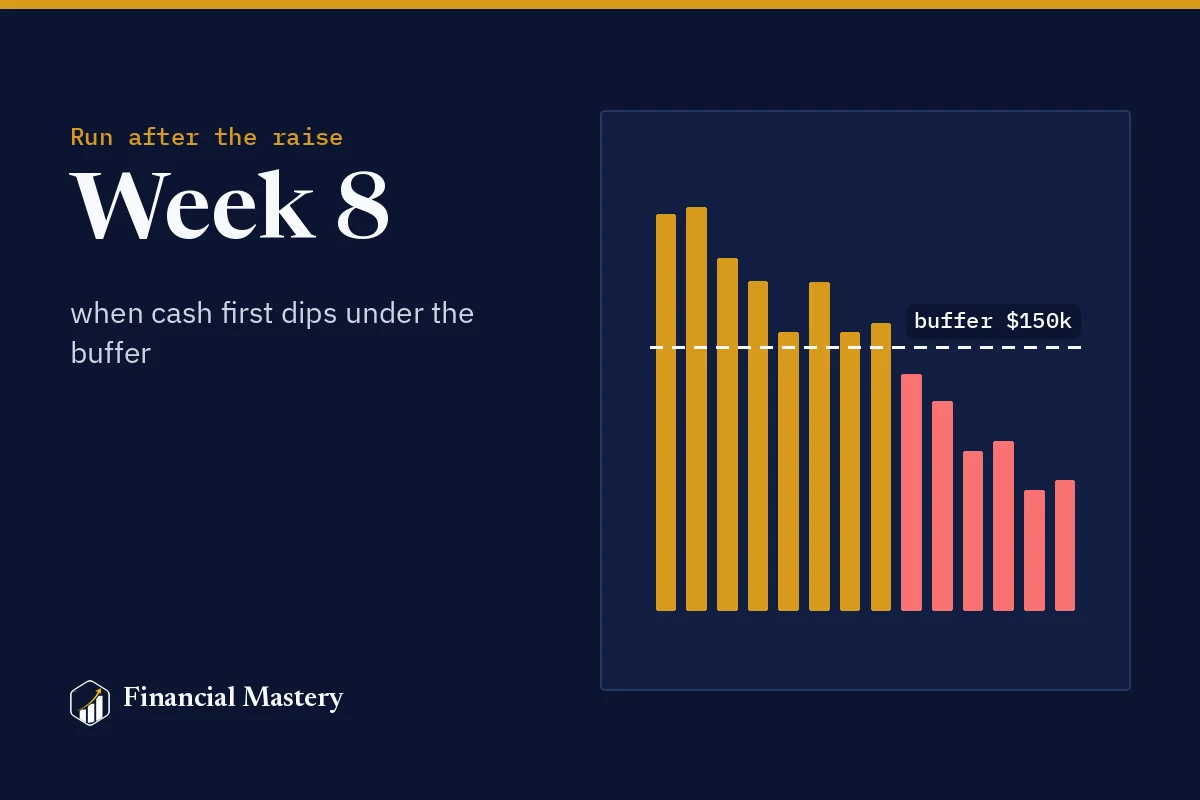
How to build a 13-week cash flow forecast and use it every Monday
Monthly forecasts hide the week your payroll and a tax bill land together. A 13-week cash flow shows it. How to build one, how to roll it every Monday, and how one company found its problem week before it arrived.
July 6, 2026
Run the company · 3 min
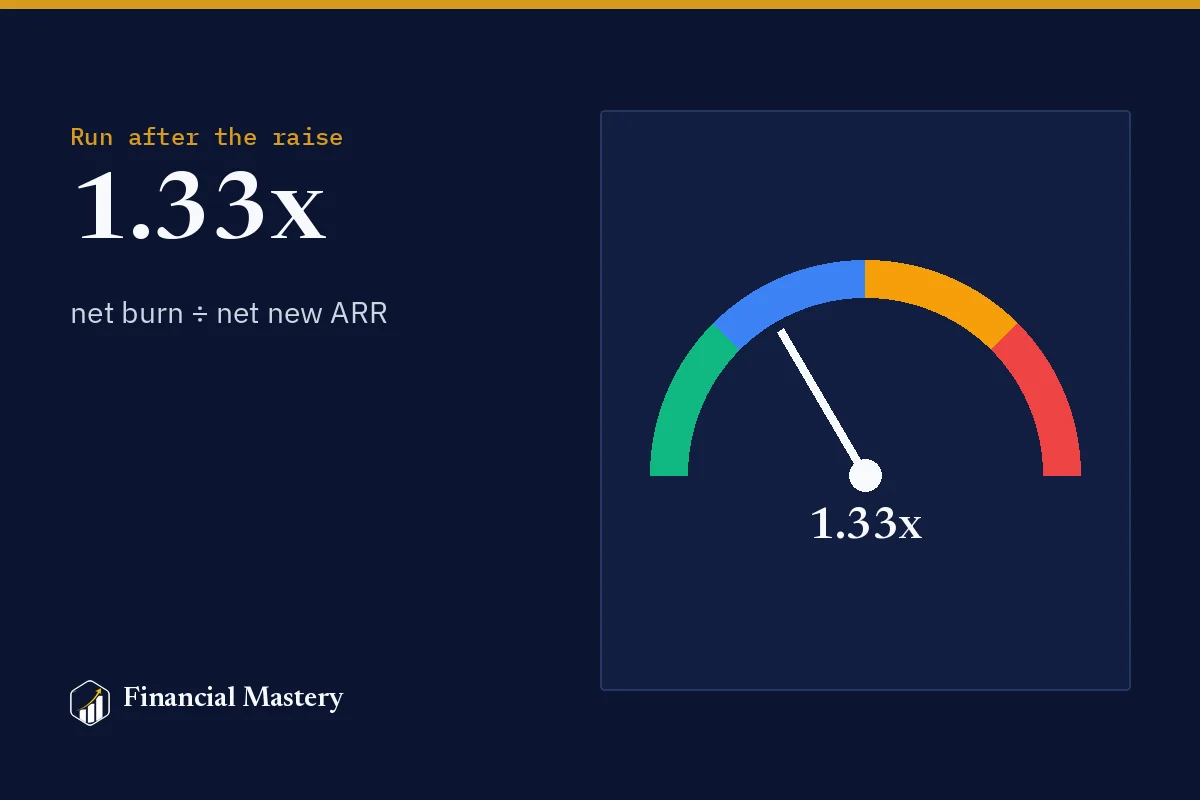
Burn multiple is the ratio your next investor will calculate
Net burn divided by net new ARR. Simple to calculate, hard to fake, and the quickest read on whether your growth is worth what it costs. With worked examples, the usual ranges and what moves it.
May 18, 2026